
Understanding "Mud": The Nightmare of Home Producers
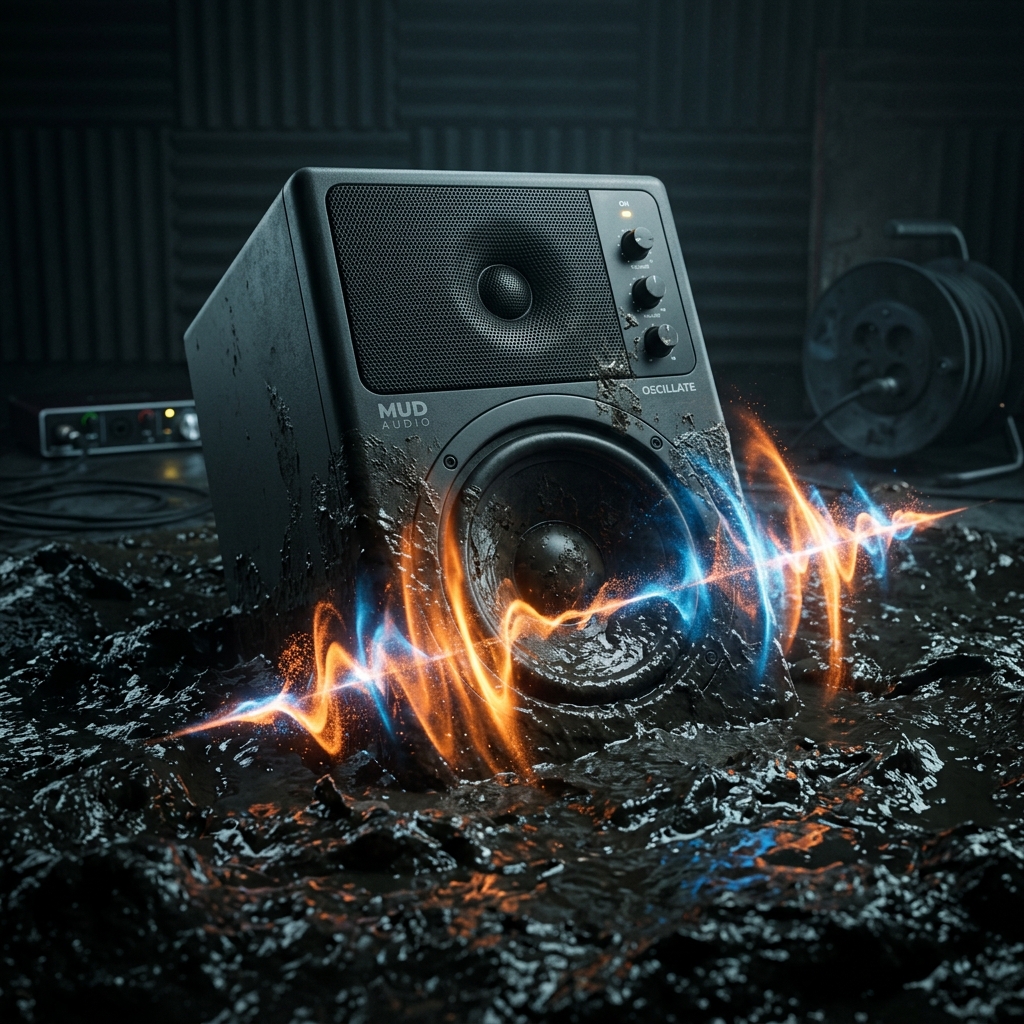
This phenomenon occurs when your track sounds as if someone draped a thick, heavy blanket over the speakers. Even at high volumes, individual elements in the mix lack definition — you can't distinguish the kick from the bass, the guitars bleed into the synthesizers forming one unintelligible blob, and the overall sound becomes flat and lifeless. Listening to such a track for more than a few minutes is exhausting.
Technically speaking, mud is a drastic accumulation of excessive acoustic energy in the frequency range of around 200 Hz to 500 Hz (the low-mids). This is where the "warmth" and "body" of most instruments live. Unfortunately, too much warmth quickly turns into a choking swamp.
The Acoustic Masking Phenomenon
Why does everything sound so "warm" and "analog" in the studio, but once you play it in the car, the music sounds like a tragic mess? The answer lies in human perception and frequency masking.
When two instruments (e.g., a deep snare and the lower notes of an electric guitar) emit energy in the 300 Hz range simultaneously, our brain struggles to separate the sources. The stronger signal completely masks the weaker one, or they sum together creating a resonant bump that rumbles and overwhelms the rest of the spectrum.
Beginner producers usually react to this problem by turning up the masked instrument. It is a vicious cycle — the mix gets louder, headroom vanishes, and the track remains one big "ball of sound." The solution lies in subtracting, not adding.
The Arrangement Flaw: Losing Before You Begin
The best mixes mix themselves if the song's arrangement is solid. Before reaching for an equalizer, ensure the problem doesn't lie within the composition itself.
- Overlapping low-register chords: Playing full triads on a piano or synth pad in the first or second octave is a recipe for disaster. In these registers, the spacing between frequencies is too tight, producing massive dissonances and immediate mud.
- Too many instruments playing at once: Ask yourself: do this wide synth pad and the massive distorted rhythm guitar really need to play at the exact same moment and in the same octaves? Shifting one of them an octave up often fixes the issue "magically".
- Overbearing basslines: Often the bass part is so dense (e.g., continuous 16th notes) that it physically leaves no space for the kick drum to decay.
Filtering: The Magic of HPF (High-Pass Filter)
The fundamental step in cleaning a mix is cutting out what isn't needed. Many instruments generate low-end rumble and sub-bass frequencies, even though they serve no musical purpose there (e.g., vocal mic plosives, guitar body thumps, pad rumbling).
How to combat this?
Apply a careful High-Pass Filter (HPF) on tracks that do not dictate the rhythmic bottom end of your song. Cutting vocals below 80-100 Hz, or hi-hats and shakers below 300-400 Hz instantly reclaims valuable headroom. This creates space for the Kick and Bass to play clearly. However, remember: don't cut too aggressively, or the mix will sound unnaturally "thin".
EQ Carving Technique
Once you are sure that only the Kick and Bass dominate the sub frequencies (0 - 100 Hz), it is time to tackle the dreaded 200 - 500 Hz range. It is time for "Carving" with an equalizer.
Identify the most important instruments in this range (usually lead vocals and snare). The background elements clashing with them (rhythm guitars, keyboards) should receive a gentle dip (-2 to -3 dB) using a bell filter at the exact resonant frequencies where they mask the lead. This creates a "pocket" for the primary element to breathe without drastically destroying the timbre of the background tracks.
Dynamics Control: Sidechain on Bass and Pads
EQ is static, but music is dynamic. If the Kick and Bass are fighting for the exact same frequencies below 100 Hz or around 200 Hz, even perfect EQ won't save you — because both need to hit hard. That is when we deploy Sidechain Compression.
When the Kick strikes, a compressor on the bass track is triggered, rapidly "ducking" the bass volume for a few milliseconds. The kick's transient takes full command, and as it decays, the bass instantly returns to its natural volume. This "pumping" effect not only clears the mud but also gives the song a modern, rhythmic bounce (highly popular in electronic, pop, and house music).
Clean Space: Don't Muddy Your Reverbs
One of the most frequent mistakes is sending full-bandwidth signals (including low-mids) into a reverb channel, or placing a reverb directly on a Kick / Bass track.
A reverb tail rings out over time, accumulating energy. Low frequencies inside a reverb create the effect of a huge, murky drum playing inside a small concrete hangar. Always apply an EQ to your Reverb Return bus. Use an aggressive HPF (sometimes cutting everything below 250 - 400 Hz). You will find that the "wet signal" becomes airy and pleasing, without masking your clean drum and bass foundation.
How Aumixys Helps Locate Low-End Mistakes?
Our Analyzer is built to warn you about invisible issues in home environments. If you work in an untreated room, there is a massive risk that your room is deceiving you, masking critical errors. Aumixys delivers ruthless, hard technical data:
- Frequency Balance Profile: By observing the charts, you can instantly catch if the Low-Mids band looks like a towering iceberg compared to reference curves. The balance bars will alarm in red, forcing a revision.
- Actionable AI Tips: Depending on the exact shape of your spectrum and dynamics, the artificial intelligence will prepare a list of precise warnings in the AI panel. From removing "boxy" snares to suggesting an HPF on your synth pads.
- Kick/Bass & Masking: The low-end integrity report calculates precise interactions between your kick and bass, scoring whether your overlap is musically arranged (which makes sense) or if it's causing a critical phase conflict and mud.
Frequently Asked Questions (FAQ)
What does it mean when a mix is muddy?
Muddiness is an excess of overlapping energy in the low-mid frequencies (around 200-500 Hz). This causes a "blanket over the speakers" effect and a lack of clarity.
How to remove mud from a track?
Apply careful high-pass filters (HPF) on tracks that do not need sub-bass (vocals, guitars, pads). Use EQ carving to make room when instruments clash.
Check it on your track
See tonal balance, low-mid energy, and areas where your mix may be losing separation.