
About the Project

Mastering practice, transparent measurement, and decisions you can trust before releasing music.

Aumixys was built so numbers can support better sonic decisions.

A good master is not just “loud”. It has to keep its energy, control peaks, survive streaming normalization, and still translate across different playback systems. That is why Aumixys combines technical measurements with practical interpretation: it shows LUFS, True Peak, LRA, dynamics, stereo, spectrum, and release-critical risks, but explains them in the language of decisions, not just tables.

I treat Aumixys as a second pair of ears for producers, engineers, and musicians. It is not meant to replace listening, experience, or taste. It is meant to catch things that are easy to miss after many hours of work: an overdriven limiter, intersample peak risk, excessive stereo width, suspicious high-frequency cutoff, over-compression, or level differences across an EP or album.

The usefulness of the report matters most. A graph alone is not enough if the user does not know what to do next. That is why Aumixys messages are written to point toward a practical next step: check the limiter ceiling, compare in mono, leave more headroom, verify transcoding, or listen against references with loudness matched.

This tool comes from studio practice, not from an abstract dashboard. A metric matters only when it helps you finish a mix or master faster and with more confidence before sending it to a distributor.

Transparently: the audio file is uploaded for the duration of the analysis, processed in the server environment, and removed after the standard analysis flow is complete. Aumixys is not a library for collecting other people's tracks; it is a QC tool designed to return a report, support a decision, and avoid pretending that measurement is magic.
🌈 Spectral Analysis (CQT)
Instead of classic FFT, we use Constant-Q Transform (CQT). This allows for logarithmic frequency distribution (48 bins per octave), perfectly mapping human hearing perception and enabling precise sub-bass and harmonic analysis.
📏 EBU R128 Standards
Loudness calculations (LUFS) and True Peak detection (oversampling) comply with international broadcasting standards, ensuring full compatibility with Spotify, YouTube, and Apple Music algorithms.
🔒 Security & Transparency
The file is uploaded only to perform the analysis. In the standard flow it is stored temporarily, processed, and removed after the request is complete. We say this clearly because trust starts with an honest description of the process.
Technical QC without Guesswork
The report combines measurement metrics with practical QC rules. You do not just get a “-10.8 LUFS” value; you get context on whether that level makes sense for mastering, streaming, album consistency, and technical safety.
Jacek Wiśniewski, creator of Aumixys and SOUNDSAAR
Behind the Code

Jacek Wiśniewski (SOUNDSAAR)

Aumixys came from a practical need: I wanted a fast, precise mastering QC tool that runs instantly in the browser and does not require another set of plug-ins to be installed on every workstation.

As a creator, producer, and mastering practitioner, I do not see audio analysis as just a table of numbers. LUFS, True Peak, LRA, stereo, and spectrum data matter when they help you make a better sonic decision before release.

That is why I combined SOUNDSAAR studio experience with code, numerical analysis, and listening-based tests. The goal is simple support for producers: less guessing, more confidence that the master keeps its energy, dynamics, and technical safety across playback systems.

When building Aumixys, I deliberately avoid the tone of an “oracle”. An analyzer should not shame the creator or reduce music to a single number. It should point out risk, provide context, and help decide whether something needs correction or is an intentional aesthetic choice.

From Amiga Trackers to Precision Mastering QC

Meet the Creator of Aumixys

My audio journey began in 1990 with the Commodore Amiga 500. It was there, creating my first compositions, that I learned that in music, every detail matters and creative approaches to technical limitations are key. Over more than 30 years, I've traveled the path from 8-bit trackers, through the era of early Cubase and WaveLab versions (1996), to modern production under the Anthares and Soundsaar banners.

As a musician, producer, and mastering practitioner with extensive experience, I've repeatedly faced the same problem: how to objectively assess mix quality before publication?

Aumixys is not another corporate product. It is a tool built by a practitioner for practitioners. I combined more than 30 years of studio experience with signal analysis, real-world audio tests, and a calm, analytical approach to sound quality. I wanted to create a place where a producer can quickly check a master, understand the result, and return to the music with more confidence.

It is especially important to me that Aumixys does not pretend to be automatic mastering or a “magical” artistic judgment. Good analysis should be honest: it shows technical problems, explains their consequences, and leaves the final decision to the human. In music, listening, emotion, and intention still come first. Measurement should support control, not take it away.
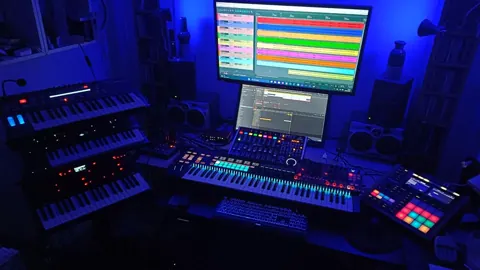
SOUNDSAAR recording studio, workspace behind Aumixys
SOUNDSAAR - the place where listening, measurement, and mastering practice meet the Aumixys codebase.
🎵 1990: The Beginning
Commodore Amiga 500, trackers, 4 channels, 8-bit samples. The struggle for every decibel and dynamic range in a world of limited resources.
🎛️ 1996: Professional Era
First versions of Cubase and WaveLab. Transition from trackers to DAW and the beginnings of professional mastering.
🔬 2020+: New DSP Era
Combining 30 years of experience with signal analysis, automated QC reporting, and practical language for producers.

"Experience from the era of limited samplers and trackers teaches respect for dynamics, spectrum, and every decibel. Modern tools give enormous freedom, but good mastering still requires the same attention: understanding what happens to the signal and why something should be corrected or left alone."

How Aumixys Builds Trust in the Result

A professional audio tool must be more than visually impressive; it has to be predictable. That is why Aumixys builds its report on established analysis libraries, loudness standards, and custom QC rules that translate measurements into practical mastering language.

⚙️ Server-side Analysis Engine
Analysis runs in a controlled backend environment using tools such as NumPy, SciPy, librosa, soundfile, and FFmpeg. This makes it possible to handle different audio formats, perform heavier calculations, and return a report independently of the user's computer power.
🎛️ Measurement plus Interpretation
A number alone is often not enough. Aumixys combines measurement with interpretation: it shows what is safe, what should be checked by ear, and what may cause problems after streaming normalization or transcoding.
📊 EBU R128 & ITU-R BS.1770
LUFS, LRA, and True Peak are interpreted in the context of ITU-R BS.1770, EBU R128, and streaming-platform practice. The report does not simply say “good” or “bad”; it explains what the result means for release.
🔬 Spectrum, Dynamics, and Stereo
Beyond loudness, Aumixys checks spectral balance, phase correlation, stereo width, crest factor, fade in/out, and signs of lossy compression. This helps evaluate not only level, but also technical robustness.
🎯 Tool Limits Are Part of Quality
Aumixys does not replace listening, an engineer, or artistic judgment. It provides a reliable warning signal and technical context. A professional tool should clearly state what it measures and what it cannot decide for the human.
🛡️ Data Security
Files are needed only to generate the report. In the standard analysis flow they are stored temporarily, processed, and removed after the request is complete. It is a simple, honest model: minimal storage, maximum clarity for the user.

Ready to check your master?